Networking
gRPC
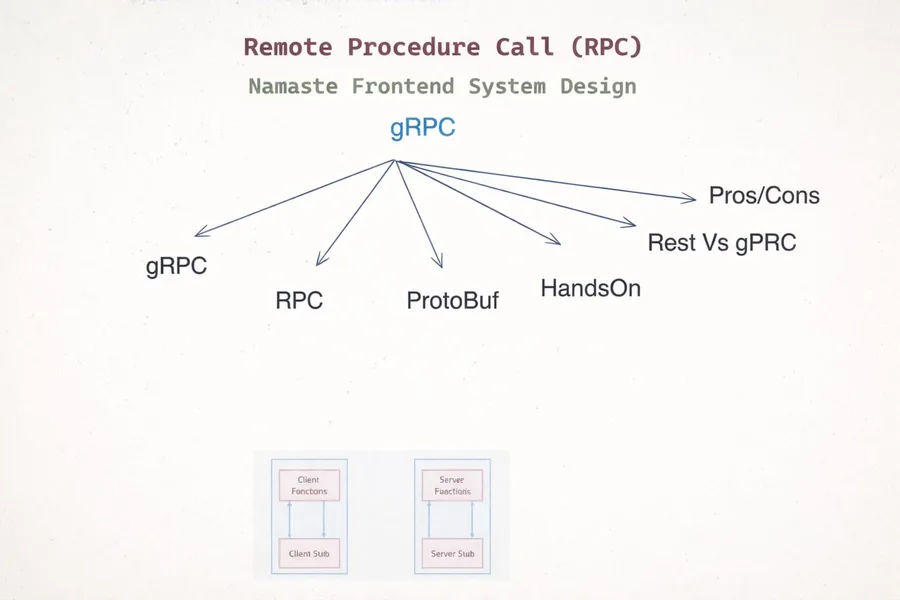
What is gRPC
gRPC (Google Remote Procedure Call) is a framework that lets a client call functions on a remote server as if they were local functions.
Why use gRPC
- Faster than REST (binary instead of JSON)
- Strongly typed (uses
.protocontracts) - Built for service-to-service communication
How it works
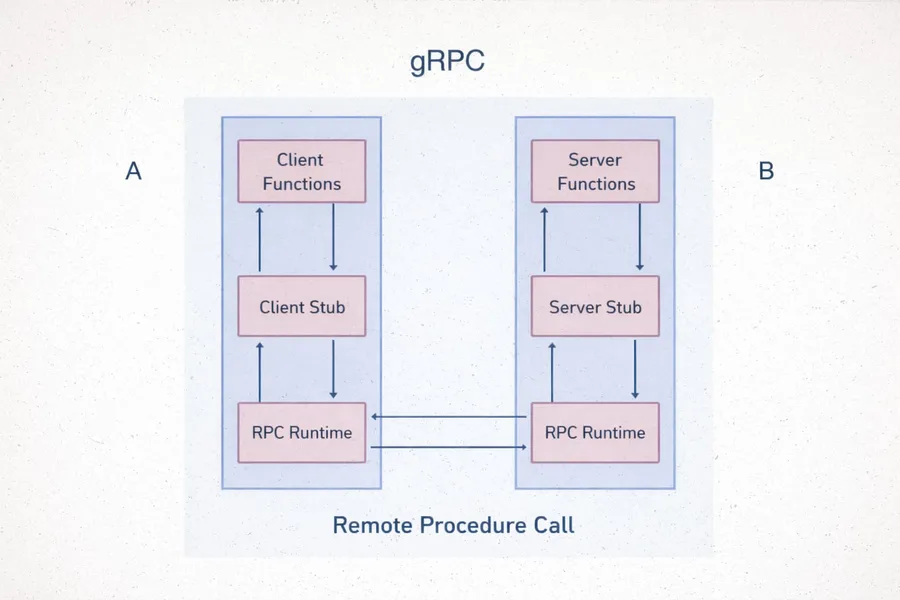
- Client Function - You call a function like
getUser(id). - Client Stub - Acts like a proxy. Converts function call → Protocol Buffer (binary format).
- RPC Runtime - Sends request over network using HTTP/2.
- Server Stub - Converts binary data back to usable format. Calls server function.
- Server Function - Executes logic and returns response.
- Response path - Server → Server Stub → RPC Runtime → Client Stub → Client.
Key concept
- Client Stub = like GraphQL resolver + API call layer
- RPC Runtime = network layer
- ProtoBuf = schema + data format
Protocol Buffers (ProtoBuf)
Protocol Buffers is a data format + contract system used by gRPC. It defines how data is structured and transferred between client and server.
Interface Definition Language (IDL)
ProtoBuf uses .proto files as an IDL. Example:
syntax = "proto3";

service UserService {
  rpc GetUser (UserRequest) returns (UserResponse);
}

message UserRequest {
  int32 id = 1;
}

message UserResponse {
  string name = 1;
}
What this does:
- Defines API methods (
rpc GetUser) - Defines data structure (
UserRequest,UserResponse) - Acts as a contract between client and server
Serialization / Deserialization
Serialization - Convert structured data → binary format. Happens at Client Stub.
{ id: 101 } → binaryDeserialization - Convert binary → structured data. Happens at Server Stub.
binary → { id: 101 }Binary Support (Why it matters)
ProtoBuf uses binary encoding instead of JSON. Benefits:
- Smaller size
- Faster transfer
- Less CPU usage
- Strong typing (no parsing ambiguity)
Key Flow
JS Object
  → Serialize (ProtoBuf)
  → Binary (over network)
  → Deserialize
  → Server Object
Benefits of gRPC
High performance - Uses binary (ProtoBuf) instead of JSON → smaller payloads, faster communication.
Strong typing - .proto contracts ensure strict request/response structure → fewer runtime errors.
Code generation - Automatically generates client + server code from .proto → less manual work.
HTTP/2 support:
- Multiplexing (multiple requests in one connection)
- Header compression
- Faster than HTTP/1.1
Streaming support:
- Client streaming
- Server streaming
- Bidirectional streaming
Cross-language support - Works across multiple languages (Node.js, Java, Go, Python, etc.).
Better for microservices - Efficient internal communication between services.
Code and Architecture
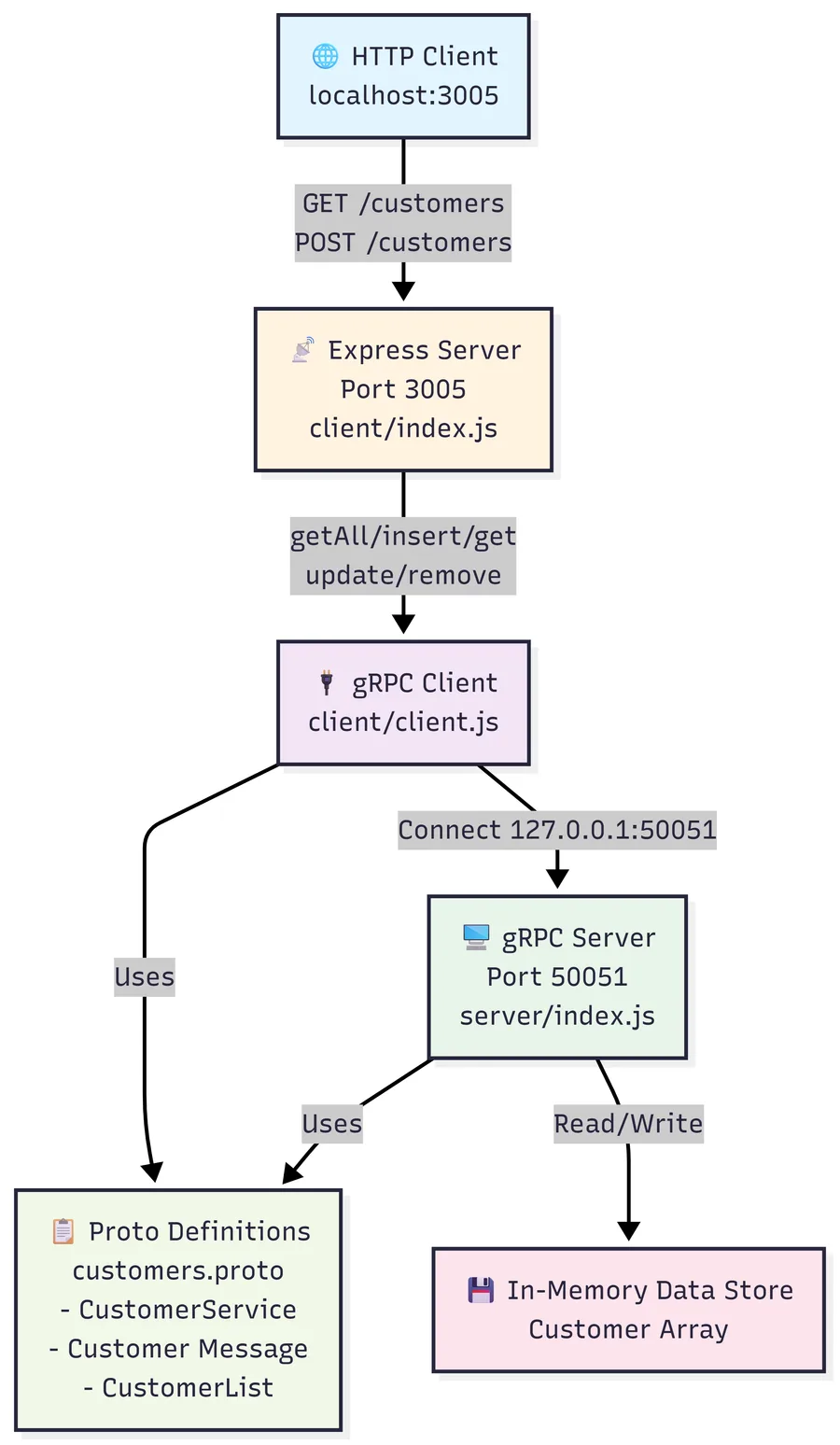
1. Initialize gRPC Server (setup)
npm init -y
npm install @grpc/grpc-js @grpc/proto-loader
2. customers.proto
syntax = "proto3";

message Empty {}

message CustomerRequestId {
  string id = 1;
}

message Customer {
  string id = 1;
  string name = 2;
  int32 age = 3;
  string address = 4;
}

message CustomerList {
  repeated Customer customer = 1;
}

service CustomerService {
  rpc GetAll (Empty) returns (CustomerList);
  rpc Get (CustomerRequestId) returns (Customer);
  rpc Insert (Customer) returns (Customer);
  rpc Update (Customer) returns (Customer);
  rpc Remove (CustomerRequestId) returns (Empty);
}
3. server/index.js
import { fileURLToPath } from "url";
import { dirname, join } from "path";

const __dirname = dirname(fileURLToPath(import.meta.url));
const PROTO_PATH = join(__dirname, "../customers.proto");

import grpc from "@grpc/grpc-js";
import protoLoader from "@grpc/proto-loader";

const packageDefinition = protoLoader.loadSync(PROTO_PATH, {
  keepCase: true,
  longs: String,
  enums: String,
  arrays: true,
});

const customersProto = grpc.loadPackageDefinition(packageDefinition);

const server = new grpc.Server();

const customers = [
  { id: "sfdjkfjsdf", name: "John Doe", age: 30, address: "123 Main St" },
  { id: "fw2342df", name: "Jane Smith", age: 25, address: "456 Oak Ave" },
  { id: "sdf2342", name: "Bob Johnson", age: 40, address: "789 Pine Rd" }
];

server.addService(customersProto.CustomerService.service, {
  getAll: (call, callback) => {
    callback(null, { customer: customers });
  },
  get: (call, callback) => {
    const customer = customers.find((c) => c.id === call.request.id);
    if (customer) {
      callback(null, customer);
    } else {
      callback({ code: grpc.status.NOT_FOUND, details: "Customer not found" });
    }
  },
  insert: (call, callback) => {
    const newCustomer = {
      id: Math.random().toString(36).substring(2, 15),
      name: call.request.name,
      age: call.request.age,
      address: call.request.address,
    };
    customers.push(newCustomer);
    callback(null, newCustomer);
  },
  update: (call, callback) => {
    const index = customers.findIndex((c) => c.id === call.request.id);
    if (index !== -1) {
      customers[index] = {
        id: call.request.id,
        name: call.request.name,
        age: call.request.age,
        address: call.request.address,
      };
      callback(null, customers[index]);
    } else {
      callback({ code: grpc.status.NOT_FOUND, details: "Customer not found" });
    }
  },
  remove: (call, callback) => {
    const index = customers.findIndex((c) => c.id === call.request.id);
    if (index !== -1) {
      const removedCustomer = customers.splice(index, 1)[0];
      callback(null, removedCustomer);
    } else {
      callback({ code: grpc.status.NOT_FOUND, details: "Customer not found" });
    }
  },
});

server.bindAsync("127.0.0.1:50051", grpc.ServerCredentials.createInsecure(), (err, port) => {
  if (err) {
    console.error("Failed to bind server:", err);
  } else {
    console.log(`Server bound to port ${port}`);
    server.start();
  }
});
4. client/client.js
import { fileURLToPath } from "url";
import { dirname, join } from "path";

const __dirname = dirname(fileURLToPath(import.meta.url));
const PROTO_PATH = join(__dirname, "../customers.proto");

import grpc from "@grpc/grpc-js";
import protoLoader from "@grpc/proto-loader";

const packageDefinition = protoLoader.loadSync(PROTO_PATH, {
  keepCase: true,
  longs: String,
  enums: String,
  arrays: true,
});

const CustomerService = grpc.loadPackageDefinition(packageDefinition);

export const client = new CustomerService.CustomerService(
  "127.0.0.1:50051",
  grpc.credentials.createInsecure()
);
5. client/index.js
import express from "express";
import { client } from "./client.js";

const app = express();
const PORT = 3005;

app.use(express.json());
app.use(express.urlencoded({ extended: true }));

app.get('/', (_req, res) => res.json({ message: "Root is groot" }));

app.get('/customers', (req, res) => {
  client.getAll({}, (err, response) => {
    if (err) {
      console.error(err);
      res.status(500).json({ error: "Internal Server Error" });
    } else {
      res.json(response);
    }
  });
});

app.post('/customers', (req, res) => {
  const { id, name, age, address } = req.body;
  client.insert({ id, name, age, address }, (err, response) => {
    if (err) {
      console.error(err);
      res.status(500).json({ error: "Internal Server Error" });
    } else {
      res.json(response);
    }
  });
});

// more routes can be added here similarly for update and delete operations

app.listen(PORT, () => console.log(`Client Started at port ${PORT}`));
Flow
client/index.js → client.js → gRPC call → server/index.js → response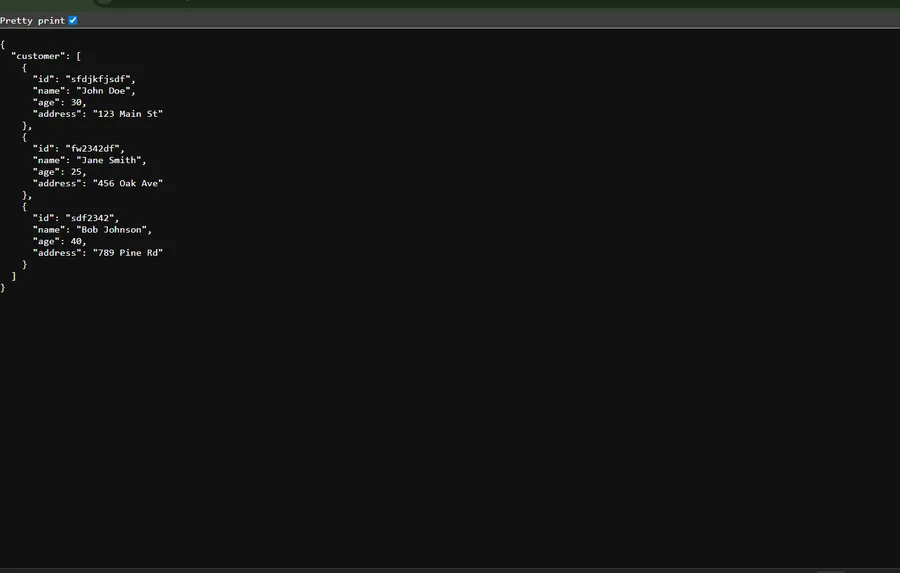
REST vs gRPC
| Feature | REST | gRPC |
|---|---|---|
| Communication Protocol | HTTP/1.1 or HTTP/HTTPS | HTTP/2 (default) |
| Message Format | JSON / XML (text-based) | Protocol Buffers (binary) |
| IDL (Interface Definition Language) | No strict standard (OpenAPI / Swagger / WSDL) | .proto files (strict contract) |
| Data Serialization | Text-based (JSON, XML) | Binary (ProtoBuf) |
| Efficiency | Slower (larger payloads, multiple requests) | Faster (compact + multiplexing in HTTP/2) |
| Flexibility | More flexible (loose schema) | Strict typing (strong contract) |
| RPC Styles | Request-Response (GET, POST, etc.) | Unary, Client Streaming, Server Streaming, Bidirectional Streaming |
| Streaming | Limited (WebSockets / SSE workaround) | Native streaming support |
| Performance | Moderate | High performance |
| Use Case | Public APIs, web apps | Microservices, real-time systems |
| Learning Curve | Easy | Slightly steep |
gRPC: Advantages vs Disadvantages
| Advantages | Disadvantages |
|---|---|
| High performance (binary + HTTP/2) | Not browser-friendly (needs gRPC-Web) |
| Smaller payload size (ProtoBuf) | Harder to debug (binary data) |
Strong typing with .proto contracts | Learning curve (IDL + tooling) |
| Supports streaming (bi-directional) | Limited human readability |
| Efficient for microservices communication | Less flexible than REST |
| Built-in code generation | Requires schema management |