AI
How AI Is Changing Software Engineering Jobs and Interviews
Two worries come up in almost every conversation with developers right now. "Will AI take my job?" and "If AI can write the code, what are interviews even testing any more?" Both are fair questions, and the honest answers are more useful than either the hype or the panic.
Here's the short version: AI has made writing code much cheaper, but it hasn't made understanding code cheaper. Companies still hire engineers to make decisions and take responsibility for what ships. What has changed is how they check for those skills, and the new things they expect you to know.
This guide covers what has actually changed in day-to-day engineering work, how interview rounds are adapting, the AI questions now turning up in interviews, and a practical plan to prepare.
What has changed in engineering jobs
AI coding assistants - GitHub Copilot, Cursor, Claude Code, ChatGPT and others - are now part of normal work at most software companies. Engineers use them to write boilerplate, generate tests, explain unfamiliar code, draft documentation and work through bugs. Many teams treat them like any other tool in the editor.

- The easy part got easier. Tasks a junior engineer once spent a day on - a CRUD form, a set of unit tests, a data-mapping function - can now take an hour. That raises the bar for what "productive" means at every level.
- Reading code became the main skill. When an assistant writes 50 lines in seconds, someone still has to decide whether those lines are correct, secure and maintainable. That someone is you, and it's harder than it sounds: AI-written code usually looks right.
- Products now have AI inside them. Search with natural-language queries, support chatbots, summaries, writing assistants. Building these needs engineers who understand how LLMs behave - including how they fail.
- Fundamentals matter more, not less. You can't judge a solution you don't understand. Engineers who know data structures, how the browser and the network work, and how their framework renders are the ones who get real value from AI tools - and catch them when they're wrong.
Will AI replace software engineers? Not the way the headlines suggest. It has replaced a lot of typing. The jobs most exposed are ones that were mostly translating clear instructions into routine code. The jobs that are growing are the ones that need judgement: deciding what to build, how to structure it, and whether the result is safe to ship.
How interviews are changing
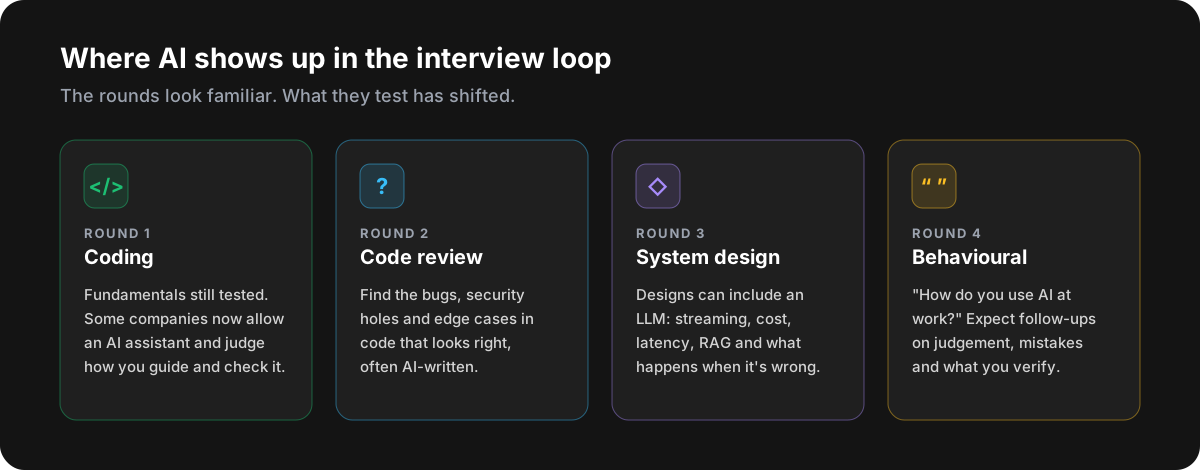
Interviews exist to predict how you'll do on the job. When the job changes, interviews follow - slowly and unevenly. Some companies have barely changed; others have redesigned their whole loop. Expect a mix of the following.
1. Coding rounds: some allow AI, most test fundamentals
A growing number of companies now let candidates use an AI assistant during the coding round, because that's how the job is done. Canva, for example, has said publicly that it expects candidates to use AI tools in some technical interviews. In those rounds, the problem is bigger and messier than a classic puzzle, and you're judged on how you steer the tool: how you break the problem down, what you ask for, and whether you notice when the output is wrong.
Many other companies have gone the other way and banned AI in interviews, sometimes moving rounds back on-site or asking candidates to share their screen and explain each line. Either way, the core skill being tested is the same: can you reason about code yourself? Don't assume you'll be allowed an assistant - always check the rules beforehand.
2. Code review and debugging rounds
More interviews now hand you existing code - sometimes openly AI-generated - and ask what's wrong with it. It works for the happy path but hides a race condition, an off-by-one error, missing input validation or an N+1 query. This round is hard to fake with AI and maps directly to the job, which is why it's becoming more popular.
3. System design with AI components
Design questions increasingly include an LLM: "Design a support chatbot over our help docs" or "Add an AI summary to this dashboard." You won't be asked to train a model. You will be asked how the feature behaves: how responses stream to the UI, what it costs per request, how you keep it fast, how it finds the right documents, and what happens when the model is wrong.
4. Behavioural questions about AI
"How do you use AI tools at work?" is now a standard question. Interviewers aren't looking for "I don't" or "for everything". They want to hear that you use it deliberately - and that you check what it produces.
Weak answer: "I use Copilot all the time, it writes most of my code."
Strong answer: "I use it for boilerplate, tests and exploring unfamiliar APIs. I review every suggestion like a pull request from a new teammate, and I don't use it for security-sensitive code without checking the docs. Last month it suggested a date-parsing fix that broke for other time zones - our tests caught it, and now I always ask it for edge cases too."
AI questions showing up in interviews
You don't need to be a machine learning engineer, but you should be able to answer these in plain English. They come up for frontend, backend and full-stack roles alike.
| Question | What a good answer covers |
|---|---|
| What is an LLM, in simple terms? | A model trained on huge amounts of text to predict the next token. It generates likely text, not looked-up facts. |
| What is a token? | A chunk of text (often part of a word) the model reads and writes. Context limits and pricing are both counted in tokens. |
| Why do LLMs hallucinate? | They produce plausible text, not verified text. Without the right information in context, they fill gaps confidently. |
| What is RAG? | Retrieval-augmented generation: find relevant documents first, put them in the prompt, then ask the model to answer from them. |
| What are embeddings? | Lists of numbers that capture meaning, so similar text ends up close together. Used for semantic search and RAG. |
| How would you stream an AI response to the UI? | Server-sent events or a streamed fetch response; render tokens as they arrive; handle cancel, errors and retries. |
| How do you keep an AI feature safe? | Never trust model output: validate it, escape it before rendering, limit what tools it can call, and keep secrets out of prompts. |
| When would you not use an LLM? | When a rule, a query or a regular expression does the job reliably, cheaply and predictably. |
If some of these answers feel shaky, the free AI course on this site explains each idea step by step - start with how LLMs read text as tokens and whether ChatGPT knows or guesses.
How to prepare: a practical plan
- Keep your fundamentals sharp. Practise some problems without AI, every week. If you can't solve a medium array or string problem on your own, you can't judge an AI's solution either. The DSA patterns guide is a good place to start.
- Practise reviewing code, not just writing it. Ask an assistant to solve a problem, then find what's wrong with its answer: edge cases, performance, security. Treat every suggestion like a pull request.
- Learn the basics of how LLMs work. Tokens, context windows, embeddings, hallucinations and RAG. One or two weekends is enough to answer interview questions confidently.
- Build one small AI feature. A chat over your own notes, a resume summariser, a smart search box. Call an API, stream the response, handle errors. One real project teaches more than ten tutorials and gives you a story for interviews.
- Prepare your "how I use AI" answer. Write down two or three real examples, including one where the AI was wrong and how you caught it.
- Talk while you solve. Whether AI is allowed or not, interviewers want to hear your reasoning. Practise saying what you're doing and why, out loud.
Common questions
Should freshers still learn to code if AI can write code?
Yes - more than ever. AI makes experienced engineers faster because they can tell good output from bad. Without fundamentals, you can't do that, and interviewers know it. Learn the basics properly first, then use AI to go faster.
Is it cheating to use AI in an interview?
It depends entirely on the company's rules. If they allow it, use it openly and explain what you're doing. If they don't, using it is cheating - and interviewers are increasingly good at spotting answers you can't explain. When in doubt, ask the recruiter before the interview.
Do I need to learn machine learning to stay relevant?
For most software roles, no. You need to know how to use models well - prompting, RAG, streaming, cost and safety - not how to train them. Deep ML knowledge matters for ML engineering roles, which are a separate career path.
Should I mention AI tools on my resume?
Mention outcomes, not just tools. "Built a support chatbot over 200 help articles using RAG, cutting repeat tickets" says far more than "Copilot, ChatGPT". If a job post lists specific AI tools, include the ones you've really used - the free ATS checker shows which keywords you're missing.
The bottom line
AI is changing how engineers work and how companies interview, but not what they are really looking for: people who understand problems, make good decisions and can explain them. Strong fundamentals plus a working knowledge of AI is the combination that gets offers right now.
Keep going: Artificial Intelligence course
Start now